The page you are on is shown in brackets [RESTRING]




 [[
[[
 ]]
]]

Guitar Page article index
GUITAR TUNING, GUITAR RESTRING &
MyCD.ca
KNOBS & SWITCHES
The page you are on is shown in
brackets [RESTRING]
[[
]]
Guitar Page article index
-----------------------------------------------------------------------
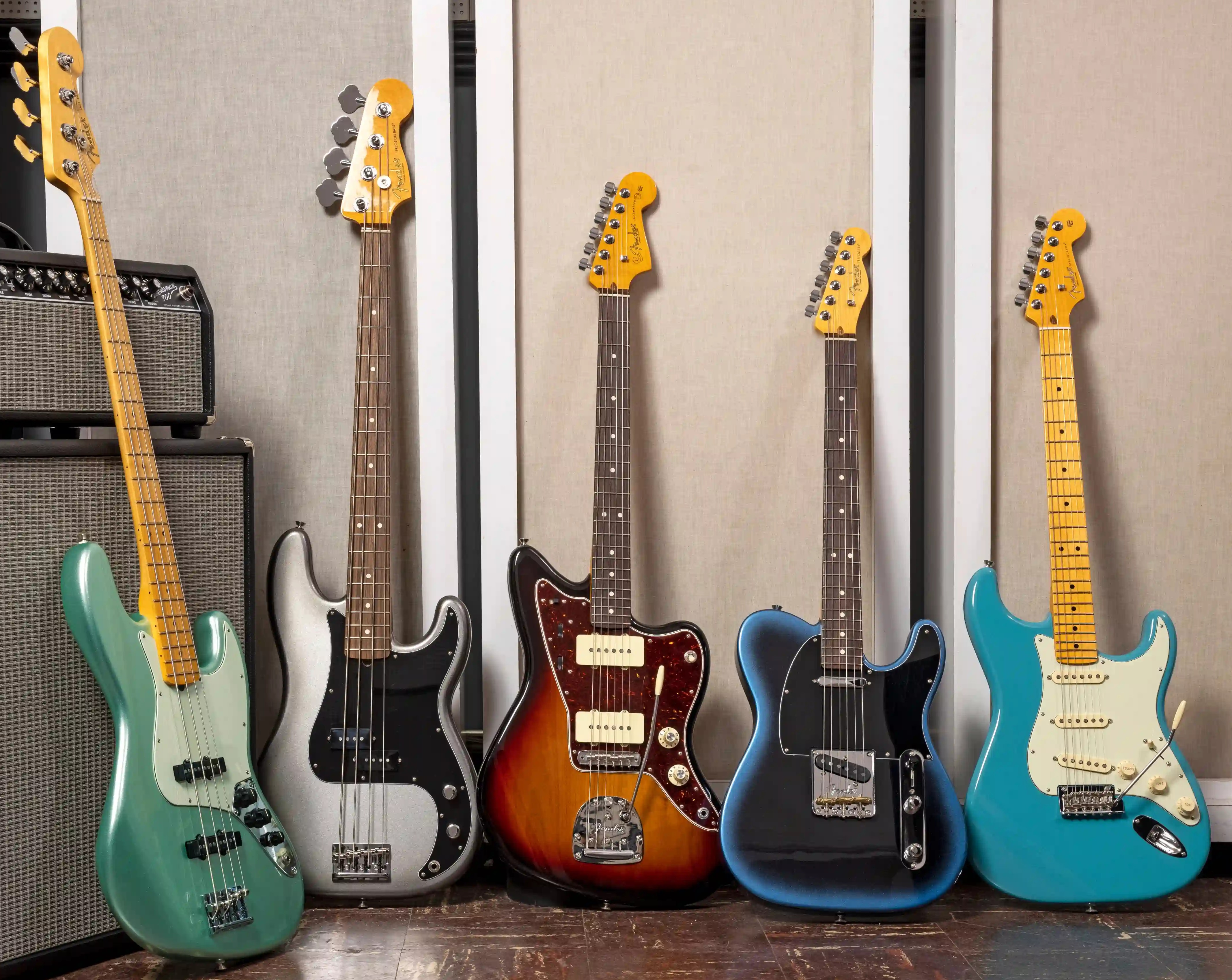
FENDER AMERICAN PRO II
--------------------------------------------------
1)
How to change the strings on your guitar
by Art Rock / MyCD.ca
Here is a full and in depth description of how to restring your guitar.
If you are new to changing guitar strings, you should read this entire article first before you start, to fully understand what is happening. If you are
asking should you wear safety glasses when you restring a guitar? It might be a good idea to put on safety glasses, to protect your eyes, the first few
times you change the strings on your guitar until you get the hang of it. I know lots of players and guitar repair techs who wear them every time they
restring their guitars.
It is easiest if you do one string at a time. Take one string off your guitar and replace it, then do the next string. I recommend starting with the first
string, the thinnest at the bottom of the guitar, toward the floor. For this guitar string is the cheapest to buy as a single string if you break it. It
happens to the best of us.
If you have a right handed guitar, you pick the strings with your right hand and fret / chord with your left hand. If you have a left handed guitar it will
be the opposite.
Now very slowly turn the first string machine head button / tuning peg at the
headstock on the left end of the neck on your guitar. Turning it one way
will raise the pitch of the string (make it higher in
pitch) turning the other way will lower the pitch.
----------------------------------------------------------------------

----------------------------------------------------------------------
On a 6 in line headstock
If you have 6 machine heads in a row on one side of the top of the headstock of your guitar (versus 3 on the top (left side) & 3 on the bottom (right
side)), when you turn the machine head clockwise it should loosen the string, lowering the pitch. For machine heads on the top side of the guitars
headstock, which is the left side, turning clockwise (cw), would be turning toward you. If you were sitting on top of the machine head you would be
turning to the right. For machine heads on the bottom of the headstock of your guitar, which is the right side, turning clockwise would be turning away
from you. This is still clockwise and still to the right
but because it is the opposite side of the guitar's headstock it is the mirror
image.
------------
Why is it Free and how you can support us.
All the articles and info we provide is completely free to you. We get very
small payments from the advertisers on our website when you make a
purchase from them, after clicking one of their ads on our site such as Amazon, Ebay, Walmart etc. You won't pay any extra for your purchase and
you will help us keep it free to you. We also get a very
small payment when you click on an adsense by Google ad
-----------------------------------------------------------

-------------------------------------
You want to keep turning the knob (cw) while you keep picking the guitar string
so that you are positive you are loosening the string (the pitch is
getting lower) If the pitch is going higher, the string is tightening. Either you are not turning the machine head clockwise (towards you for a 6 in line,
on top) or the guitar string could be on backwards. Turn it in the direction that loosens the string until the string almost falls out of the string post on
the headstock. Unwind the string from the post at the machine head and pull it out of the post noting the hole where the string goes through. Now at
the other end of your guitar, where the bridge is, the right end where the output jack is, where you plug your guitar in. There is a little ball on that end
of the string. Look for the end of the string. Sometimes there is a hole through a metal bridge plate, screwed on to the surface of the guitar body.
Sometimes the guitar string goes down through the bridge,
through the guitar body and exits out the back of the guitar.
If it does, usually you will see a plastic plate with 6
holes in it. One for each string. Push the string and see where it goes through.
On an acoustic guitar the ball of the string could be through a hole drilled through the end of the wooden bridge, although usually the ball end of the
guitar string goes through a hole in the top of the acoustic guitar body and is held in place with a bridge pin. If your acoustic guitar has bridge pins
you will see six little plastic looking balls on top of the guitar bridge where the guitar strings goes through the body. What you are seeing is the head of
the bridge pin. The bridge pin is about one inch, about 2.5 cm, long and is tapered at the other end. Try to grab the ball with your fingers and pull the
pin straight out. Make sure the string is completely loose or the pin could shoot out. If you can't pull it with your fingers a bridge pin puller is the ideal
tool. Assuming you don't have one you can use a pair of needle nose pliers, but be gentle, they break easily. If you do break the pin see our guitar
maintenance article, coming soon on how to fix it. Pull
the pin and then the string out of the hole in the guitar top.
In your new pack of strings, if they are in 6 separate envelopes the gauge of the string will be on the outside of each envelope. A set of electric guitar
light gauge strings typically will be .009, .011, .016, .024, .032, .042. The lower the number (.009) the thinner the string. The higher the number
(.042), the thicker the string. The 6th string, thickest is at the top of the guitar, towards your face, not towards the floor. To make things easier you
can number the packages with a pen .009- number 1, .011-#2, .016-#3, .024-#4, .032-#5 and .042-#6. If your strings are 10 gauge then mark
them .010-#1, .013-#2, .017-#3, .026-#4, .036-##5, .046-#6.
--------------------------------------------------------------------------------------------
JUST RELEASED MAY 8TH 2026

--------------------------------------------------------------------------------
Start from the bridge side of the guitar, feed the plain end of the string, (not the ball end), back through the hole in the bridge, the same way your
other strings still on your guitar are going, then pull the string down across the fret board / fingerboard to the headstock, through the hole in the
machine head post / tuner. Pull the string all the way through, make sure the ball is seated at the bridge. Now hold the plain end with your left hand
and place your right hand under the 6 strings, between the pickups of an electric guitar or over the round sound hole of an acoustic guitar. Loosen up
with your left hand so that your right hand can stand on its side like your were going to karate chop the guitar top. You want to raise the strings
roughly 4 fingers high with your right hand and pull the slack through the hole in the machine head with your left hand. Now with your left hand bend
the string up at the machine head, on the far side of the hole that the string is fed through. Bend the the string straight up in the air, right where it
exits the hole. (On a lot of bass guitars, there will a hole down the center of the string post where the end of the string goes in and then bends over,
through the groove in the machine head of your bass guitar) (Classical guitars / nylon string guitars usually have a plastic sleeve over a sideways
metal post with a hole through it to feed the guitar string through ) Now grab that plain end of the guitar string with your right hand and hold the
string on this side of the machine head as well. So now you are holding the slack up in the air on this side of the machine head and the plain end on
the other side. Hold it a little tight. Now with your left hand turn the machine head counter-clockwise (ccw) which is away from you if its the top or left
side of the guitar headstock, or would be toward you if the machine head is on the bottom or right side of the guitar headstock. Remember both of
those are still (ccw) counter-clockwise. Try to get the string to start at the top of the string post, just under the hole on the post, and let it wind down
the post as you turn the knob. Usually the 4 fingers slack you started with will wind the string from the top of the post to the bottom of the post. Hold
it tight with your right hand. If it feels like its cutting in your hand, loosen up so it doesn't. It is a steel wire and could probably cut your hand if you
pulled it hard enough. You might want to wear gloves if your hands are tender. As you wind down the post the slack in your right hand will go down to
nothing, the string will end up right on the fret board. Place the string in the groove in the nut slot, same as the other strings. The nut is the plastic
looking piece with 6 grooves in it, one groove (or nut slot) for each guitar string.

Start picking the string, make sure it is lower in pitch than it should be. Use your tuner to tune it accordingly. Tuning the guitar is in another article
here. Then repeat everything with the 2nd string, (maybe it is .011,.013 or?) depending on the guage of the guitar strings you bought. Then repeat the
same for the 3rd string , then the 4th, the 5th, and then 6th guitar string. Once the guitar is tuned up and everything is good, you can cut the ends of
the strings off with side cutters maybe 1/2" from the other side of the post. Later on you can cut it shorter if you like. Make sure it is bent up at a 90
degree angle before you cut it.
The alternate way to place the guitar string on the machine head post is to pull it around the post and under the string after you feed the string
through the hole in the post. The method we are showing you above is an easier way to put the string on. The other advantage in putting the guitar
string on this way is that there tends to be less string
breakage at the post, especially if you are a hard player.
On a 12 string guitar you have one pair of each of the six strings. The 12th
&11th string would be the same as the 6th string, the low "E" on your six
string guitar. The 10th and 9th string would be the same as the 5th string, the "A". The 8th and 7th string would be the same as the 4th string, the
"D". The 6th and the 5th string would be the same as the 3rd string, the "G". The 4th and the 3rd string on the 12 string guitar would be the same as
the 2nd string, the "B" on the six string guitar. Then the 2nd and 1st strings would be the same as the first string, a high "E". High signifies that the
note is higher in pitch.
--------------------------------------------------------------------------------
JUST RELEASED

--------------------------------------------------------------------------------
On the twelve string guitar, the four pairs of bass strings, the low "E", the "A", the "D" and the "G" strings each have one thin string and one thick
string in each pair. The thicker string is tuned to the note the same as the six string guitar would be. The thin string is tuned to the same note but one
octave higher in pitch.
On each pair of strings the top string is the thinner one and the bottom string
of each pair is the thicker. So you have 12 thin, 11 thick, 10 thin, 9
thick, 8 thin, 7 thick, 6 thin, 5 thick. This is designed this way so the guitar pick will sound both strings. The first two pairs of strings, are the same
thickness and tuned to the same pitch. The 4th and 3rd strings on the twelve string guitar are both tuned to the "B" note, both the same pitch. The
2nd and 1st string are both tuned to the high "E" note, both the same pitch.
A handy tool to get is a string winder. You can get a cheap plastic one for two or 3 dollars, which will do the job good enough. Most of them have a
"U" shaped notch cut out of the edge of it. This is used as a bridge pin puller to pull the plastic pin out of an acoustic guitar. You slide the "U" shaped
notch over the stem of the pin just below the ball of the guitar bridge pin and gently lean it back, popping the pin out. Make sure the string is
loosened first.
The string winder itself slips over top of the machine head button on your
guitar. Now you can turn the handle making it a lot easier to wind the string.
See our Tuning your guitar article on this page if you need help to tune your
guitar.
This has been based on an electric guitar with a fixed or strat style tremolo
bridge, or an acoustic guitar, not a guitar with a Floyd Rose style floating
bridge. That will be covered in a future article.
article by Art Rock / MyCD.ca / Absolute Music copyright Absolute Music 2020 all
rights reserved TOP of Page

------
2) HOW TO TUNE YOUR GUITAR by Art Rock MyCD.ca
This is a comprehensive and full explanation on how to tune your guitar. If you
are new to guitar tuning read the entire article first before you start.
Tuning your guitar
Here is how to tune an acoustic guitar, electric guitar, bass guitar, or 12
string guitar. This is a complete explanation which should answer all your
guitar tuning questions. Once again It may be a good idea to put on safety glasses, to protect your eyes, the first few times you tune your guitar until
you get the hang of it.
Let's name a few parts before we start.
If you have a right handed guitar, you pick the strings with your right hand and
fret the notes / chord with your left hand. If you have a left handed
guitar you will be doing the opposite. Your 6 machine heads are on the headstock of your guitar which is the extreme left end of your guitar, on the
end of the guitar's neck . If you have a left handed guitar it will be on the opposite end of your guitar. Your guitar strings have a ball on the right side
end that is held by the bridge. The other plain end of
the string goes through a hole in the machine head post.
Turning the machine head button, (also known as the tuning peg or tuner) one way
tightens the string, turning the other way loosens the string. When
you tighten a guitar string the pitch of the string goes higher, when you loosen the guitar string the pitch of the string goes lower. When you turn the
machine head clockwise (cw) it should loosen the string.
When you turn the machine head button counter-clockwise (ccw) it should tighten
it.
Clockwise, like the second hand on a clock or watch turns to the right. If your guitar is doing the opposite the string is probably on backwards. Next
time you change the strings you can fix it. See our
string changing article on this page.
If you have a guitar with all 6 machine heads on one side on the top of the headstock of your guitar , also known as the left side of the headstock, to
tighten the string you will be turning all of the machine heads counter-clockwise (CCW), (to the left), (away from you). If you have a guitar with 3
machine heads on each side of the headstock. The 3 on the top or left side of the headstock turn CCW (to the left), (away from you) and the 3 on the
bottom of the headstock, (or the right side of the headstock) CCW (to the left) (towards you). Because they are mounted opposite (upside down),
compared to the top heads, they are the mirror image but
you are still turning them CCW, still to the left. That does not change.
It is a good idea to stretch your strings before you start to tune your guitar.
If the guitar strings are old or have been sitting for an extended period of
time, sometimes a string may break when you first turn it. To stretch them place your index finger of your left hand on the first fret from the
headstock. (the space between the plastic nut and the first thin metal fret bar) With your right hand grab the string between your thumb and index
finger (around the pickups on an electric, over the sound-hole on an acoustic guitar) and gently pull the strings away from the top of the guitar a few
times. Do one string at a time.
----------------------------------------------------------------------------------
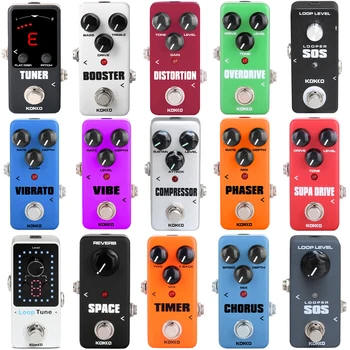
NEW GUITAR EFFECTS UNDER $10.
Standard tuning on a guitar is 6th string to an "E" note, 5th string to an " A" note, 4th string is a "D" note, 3rd string is " G", 2nd string is "B", and the
1st string is an "E".
If you have a clip on tuner, clip it on to your headstock and angle the screen so you can see it in a playing position. If you have a rectangular plug in
tuner, plug your electric guitar or acoustic-electric
guitar's patch cord into the input plug on the guitar tuner.
Turn the volume on the guitar to maximum, fully
clockwise, or to the top #10 on a slider, to allow the sound to go through the
cable into your tuner.
You probably have a built in mic on that rectangular tuner as well for an
acoustic guitar that doesn't have a pickup. Hold the tuner's microphone close
to the sound-hole on your acoustic guitar.
Turn your tuner on and you should see A440 displayed on
most tuners. Usually somewhere you will see "calibrate" and a
marking on two buttons. Pressing one will increase the number the other button
will decrease it.
Set it to A440 if it is not showing that. Now pick the 6th string, which is the thickest string at the top of the guitar, nearest to your face. It should read
an "E" note on your tuner. If it reads a lower note such as D, C or B you have to tighten the string to raise the pitch. Turn it very slow, just a little at a
time until you get used to it. If the note reads higher than an E such as F, G, A, you have to loosen the string to lower the note. You should be picking
the open string which means without pushing down on a fret with your left hand. If you are more than 2 notes away see the tuning appendix notes. If
your tuner has a dial (mechanical or LED) you want it to
be dead centre in
the middle of the scale on the display screen of the meter on your guitar tuner.
Usually a green LED will go on to indicate it is dead on. If you have
LED bars, you will see when you loosen the string the the bars go one away, when you tighten the bars display the other way. Usually there is a green
light (sometimes a different colour) right in the middle,
indicating that the guitar is right on the note.
Adjust each string to get it dead on the note. Now the 5th string, 2nd from the
top, from your face, 2nd thickest string. Pick and see if you get an "A"
note. If the display says the right note but the dials is to the left or right of the centre. Turn the machine head slightly to bring the needle or LED
segment to the centre in perfect tune. When you are tuning the 5th string which is an "A" note, if you read a G note on the guitar tuner you have to
tighten the string to bring it up to pitch.
------------------------------------------------------------------------------------------
3m 10' CORD UNDER $7.
----------------------------------------------------------------------
The notes in music go from A to G then repeat. So when your 5th string is in
tune to an A. If you loosen / lower the
string it will show a G then F, then E. If you tighten from A it will show B, C,
D. If you are just one note away it is more likely that you are in fact only
one note away, not 11 notes away which it would be if you
turned the tuning peg the other way.
Repeat for the 4th guitar string, tuning it to a "D" note. Repeat for the 3rd
guitar string tuning it to a "G" note. Tune the 2nd string to a "B", and the
first string, which is the thinnest, located at the bottom of the guitar body, towards the floor to an "E".This "E" will be much higher in pitch then the
6th string low "E". The thinner a guitar string is, the
higher the pitch that it can be tuned to.
If you recently changed your strings it is a good idea to give them a good
stretch again and then check the tuning again.
If your guitar is a long ways away from the note and you suspect children or
someone was turning the tuning knobs, loosen the string until it drops
way lower than what you think it should be, then slowly tighten and bring it up to pitch. You could also take it to a music store and get them to tune it
for you the first time. The usual charge is around $5.to
$10. , but ask first.
It is a good idea to tune your guitar every time you pick it up to play it. That
way you will always be close to being in tune to make it easier, plus you
will develop a good ear for the notes, and when they are or aren't in tune.
---------------------------------------------------------------------------------------------------------------------------------------------
DOUG ROCKS HARD ROCK, PROG ROCK,
METAL & ALT ROCK SPOTIFY PLAYLIST

From 60's, 70's Deep Purple, Led Zeppelin, Black Sabbath,
Jethro Tull, Rush, to 80's, 90's , AC/DC, Metallica, Iron Maiden,
The Cult, Soundgarden, Tool to 2000's current, & new up &
coming artists not yet discovered . Playlist is at:
https://open.spotify.com/playlist/4FuwJjsoV2320LxfIeRhh8
To submit your original Rock song go to:
https://play.soundplate.com/doug640
--------------------------------------------------------------------------------------------------------------------------------------------
How do you tune a bass guitar? you ask. Tuning a bass guitar is basically the
same as tuning an electric guitar except for the tuning of the strings. On
a standard 4 string bass guitar, tuning is the same as the bottom four, lowest strings on the six string guitar. They are tuned to E, A,
D and G. The 4th string on the bass guitar, which is the thickest string at the top of the bass, is tuned to an "E" note same as the 6th string on a
regular guitar. The 3rd string on a four string bass is tuned to an "A" note. The 2nd string to D and the first string, the thinnest bass string on the four
string bass guitar is tuned to a G.
-----------------------------------------------------------------------------
NEW GUITAR EFFECT PEDALS
FOR LESS THAN $7.

---------------------------------------------------------------------------
On a 5 string bass guitar the bass strings are tuned, from thickest to thinnest, top to bottom, Low B, E, A, D, G. As you can see the first 4 strings of
the five string bass guitar are tuned the same as the four strings on the four string bass guitar. The added string on a five string bass guitar is a low B,
a thicker bass string place in the 5th string spot at the top of the bass guitar, closest to your face and the ceiling. A six string bass guitar has the
same five bass strings as a five string bass guitar. The added sixth string is a thinner string at the bottom of the bass guitar, closest to the floor. It is
tuned to a high C note. So the tuning on the six string bass guitar from thickest to thinnest string, from top to bottom is Low B, E, A, D, G, High C. You
will need a chromatic tuner to tune a bass guitar tuner that has a bass guitar mode with the bass string notes you need. A regular six string guitar
tuner will not have the B or the C note.
On a 12 string guitar you have six pairs of
each of the six strings. The tuning is still E, A, D, G, B and E same as the six
string but you have two of each
string. The 12th &11th string are the same as the low E sixth string on a six string guitar. The 10th and 9th strings are the same as the A note fifth
string on a six string guitar. The 8th and 7th strings are the same D note as the 4th string on a six string guitar. The 6th and the 5th strings are the
same as the G note 3rd string on a six string guitar. The 4th and the 3rd strings are the same B note as the second string on a six string guitar. Then
the 2nd and 1st strings are the same as the first string, a high "E" on the six string guitar. High signifies that the note is higher in pitch.
----------------------------------------------------------------------

----------------------------------------------------------------------
each pair. The thicker string is tuned to the note the same octave as the six string guitar would be. The thin string is tuned to the same note but one
octave higher in pitch. The thinner string allows it to be tuned higher. If your twelve string is properly strung, the thin string should be on top and thick
string below the thin string on each pair of strings for
the four low pairs.
Therefore you should have from top to bottom on your twelve string 12th string,
thin E string one octave higher, 11th string, thick Low E standard
octave, 10th string, thin A string one octave higher, 9th string, thick A string, 8th string, thin D string one octave higher, 7th string, thick D string, 6th
string, thin G string one octave higher, 5th string, thick G string, 4th and 3rd string both tuned to B same octave, 2nd and 1st string both tuned to
standard high E same octave.
It is a good idea to stretch the strings on a twelve string guitar before you
tune it by placing your index finger of your left hand on the first fret of the
twelve string guitar and holding the string between your thumb and index finger of the right hand. Then gently pull the string away from the top of the
guitar body upwards . with your right hand. I repeat the word gently. This can help prevent the strings from breaking while you tune it. The 6th string
on the twelve string guitar, the high G, the thin G, is prone to easily breaking. Luckily this is the cheapest single string you can buy. Usually it is a .010
gauge. Usually stores sell it for around 99 cents.
--------------------------------------------------------------------------------

--------------------------------------------------------------------------------
The notes in music, on your guitar and on your tuner go
from "A" to "G" then repeat.
When you pick your 6th string open you get an "E". when you pick and play the
12th fret on your sixth string you get an E as well, but this "E" is one
octave higher in pitch. If you have a 24 fret guitar you will get a 3rd E at the 24th fret that is 2 octaves higher than the open E note of your six string
guitar.
If your guitar is way out of tune and you are already above the octave where the
note should be and you keep tightening the machine head, the pitch
keeps increasing as does the note on the tuner but you probably wont get to the E again, the E that is one octave higher without the string breaking
first or damage occurring to the guitar. To avoid this, if in doubt, follow the instructions in turning to loosen the string so you are sure it is lower then
the note , then slowly tighten the string and watch the note on the dial of your guitar tuner increase. If you are tuning the 6th string, and you know
you are way below and read a B note, you turn the machine head to tighten the string. As you keep tightening the string you will see the note change
to C, then to D, then to E.
You are probably wondering why would the string break during tuning or how would the guitar get damaged. The string on a guitar is made from a
steel wire. The lower strings 6, 5, and 4 have a steel wire like the 1st and 2nd string, then they have another steel wire wrapped around that wire from
one end of the string to the other end. An acoustic guitar has a wood bridge glued to a wood body. When you crank up the machine head and pull
that steel wire way too tight, what do you think will give first, the glue on the bridge or the steel. If its the 1st or 2nd string they will probably break
first. But if its the 5th or 6th string they don't break that easy. If the string doesn't break, the glue on the bridge will, then you will see a space under
the back of the bridgeon your acoustic guitar. If you keep turning and tightening the string, the tension will pull the wooden bridge right off the top of
the guitar. If the bridge has bolts and nuts through the
top, the top may break as well.
Tuning one string to another.
This was the only way in the days before electronic tuners. You would use a
little pitch pipe (horn) or a tuning fork to give you one of the guitar strings
and then you would tune the other guitar strings from that string.
--------------------------------------------------------------

-------------------------------------------------------------------------------------
When your guitar is in tune, if you pick the 5th fret on the 6th string and then
pick the open 5th string you find they are both an "A". The 5th fret on
the 5th string is the same as the open 4th string on your guitar which is a "D" note. The 5th fret on the 4th string is the same note as the open 3rd
string a "G". Now it changes to the 4th note on the 3rd string is the same as the open 2nd string a "B". And then the 5th note on the 2nd string is the
same as the open 1st string an "E".
If when you compare the 2 notes you are out and you don't know which way to turn
the machine head , here is how you can tell. First you have to
know which of the 2 strings is the one that is in tune. Let's assume you used a pitch pipe or tuning fork that was an "A" note and you tuned the open
5th string of your guitar to that A note. Now the 5th fret on the 6th string should be, the same as that open 5th string, an "A" note. If it isn't pick the
6th fret on the sixth string, then the 7th fret, 8th fret. Are you getting closer or further away? If further, pick the 4th fret, 3rd fret, 2nd fret until you
find the note that is the same as open 5th string. If the note you have to pick on the sixth string is lower than the 5th fret, (eg. 4th, 3rd) you have to
loosen the string. If the note on the 6th string that is the same as the open 5th string is higher than the 5th fret (eg. 6th, 7th) you have to tighten the
6th string. For example if the 7th fret on the 6th string is the same as the open 5th string, you have to tighten the 6th string to raise the pitch. As you
turn it in the direction to tighten the guitar string, you will find that now the 6th fret on the 6th string is the same as the open 5th string. Keep
tightening the string and then you will find the 5th fret
on the 6th string, will be the same note as the open 5th string on your guitar.
You can use this approach with a tuner as well to find out how far you are away. Keeping your guitar in tune is the best practice and if there are small
children that will turn the tuning knobs store your
guitar in a case or in the closet or get a wall hanger and hang it high.
There you go everything you need to know on how to tune a guitar and a lot more.
article by Art Rock / MyCD.ca
-------------------------------------------------------------------------------------------------------------------------------------------
$
$
-------------
4) WHAT DO THE KNOBS AND SWITCHES DO?
by Art Rock MyCD.ca
What do the knobs and switches on my guitar do?
Depending on the make and model of electric guitar, their operation can vary
from make to make but generally they will follow this m.o.
Strat Style
If you have 3 pickups , a 5 position switch and 3 dial
knobs which would normally be a strat style guitar, usually they will work like
this.
First lets verbally label the parts. If you have a right handed guitar that means your pick is in your right hand and you are fretting / chording with your
left hand. If you have a left handed guitar, everything
will be the mirror image, opposite.
Your pickups are the rectangular bars under the strings, at a right angle to the string. Usually you can see one round magnet lined up under each
string. If the pickup has a cover over it, you will not see them. The pickup on the left, closest to the headstock is the neck pickup. The headstock is
where the 6 machine heads/tuners are where you
tune your guitar. The pickup on your far right is the
bridge pickup. The middle pickup is called the middle pickup.
The 5 way switch has 5 positions, position number 1 is the far right toward the
bridge, number 5 is the far left towards the headstock. Position 3 is in
the middle.
When position 1 is selected, (Bridge-far right), the sound goes through the neck pickup only. Position 2 the sound goes through the neck and the
middle pickup. Position 3 (middle) the sound goes through the middle pickup only. Position 4 the sound goes through the middle and neck pickups.
Position 5 (far left) the sound goes through the neck
pickup only.
On the three knobs. The knob to the left, (headstock side) is the volume control
for all three pickups The knob in the middle is the tone control for the
neck pickup only. The
knob on the right (bridge side) is the tone control for the middle pickup only. There is no tone control for the bridge pickup. This is generally how a
Fender Strat would be
wired, but I have seen many different variations on various different makes and models of guitars. Plus if you bought a used guitar it is not
uncommon for people to guess
------------------------------------------------------------------------
------------------------------------------------------------------------
where a wire came off and to solder it in a different
spot which can change the operation.
When the volume knob is turned fully clockwise the volume will be at its
loudest. Fully counter-clockwise the volume will be at or near zero.
When the tone knob is turned fully clockwise the treble is enhanced meaning the bass is reduced. When the tone knob is turned fully counter-
clockwise the treble is reduced and the bass is enhanced.
On the same guitar with a 3 position switch, instead of a 5 position switch,
switch position 3, (far left)( neck position) is neck pickup only. Middle
position is middle pickup only, right position (bridge)
is bridge pickup only.
The bridge pickup will naturally give you more treble / a sharper tone. The neck
position will give you a bassier tone. On some 3 way switches, the
middle position will turn all three pickups on.
-------------------------------------------------------
As an Amazon Associate I earn from qualifying purchases
GUITAR EFFECT PEDAL
SALE AT AMAZON
--------------------------------------------------------------------
Les Paul Style
On a 2 pickup, 4 knob, 3 way switch arrangement.
When the pickup selector is in position 1, (bridge-far right) the bridge pickup only will be on. When the pickup switch is in the neck position, (far left),
only the neck pickup will be on. When the switch is in
the middle position both pickups will be on.
The 2 knobs on the left side are for volume. (one knob above the other) The 2
knobs on the right side are for tone. (one above the other)
The volume knob on the top left (neck side, closest to
your face) is for the neck pickup.
The bottom left volume knob (neck side, bottom knob, closer to the floor) is the volume control for the bridge pickup, (far right pickup). If the pickup
selector is in the neck position the top left volume knob must be up (clockwise) for sound to come out of the neck pickup. If the selector is in the
bridge position, the bottom left volume knob must be up,
(cw), for the sound to come out of the bridge pickup. When the pickup
selector is in the middle, the neck volume usually works the neck pickup, and bridge volume knob works the bridge pickup. On a lot of guitars both
knobs have to be up at
----------------------------------------------------------------------
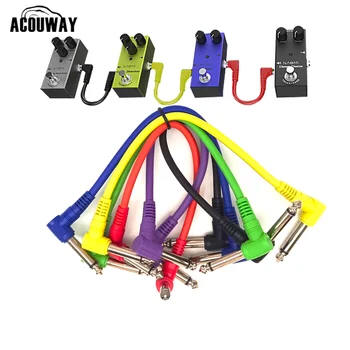
EFFECT PEDAL SHORT CORDS UNDER $7.
-----------------------------------------------------------------------
least a little or no sound will come out. Even though you are in the middle position and both pickups are on, if one of the volume knobs is at zero no
sound will come through. On some guitars it doesn't
matter. On some guitars the two volume knobs work both pickups.
There are many different ways a guitar can be wired. The more pickups, switches and knobs the more combinations there are. It is not uncommon to
have on the exact same
model of guitar to have different models have different switching action, especially guitars with 5 way switches and especially if made off shore.
Usually there are hundreds of
different people wiring them up and it is not uncommon for them to misread the wiring schematic or do it their own way. When the guitar gets to the
quality check, they may only get noticed if there is no
output at all in one of the positions.
On a 2 pickup, 2 knob, 3 way switch guitar.
Switch in neck position, neck pickup on. Bridge position, bridge pickup on, Middle position, both pickups on. Knob on the left controls volume. Knob
on the right tone.
On a guitar with 1 pickup, 1 knob and no switch. Volume only. No tone control.
When you get additional switches usually smaller in size, usually placed below
the tone selector switch, sometimes they are a coil tap. The sound
signal only goes through half of the windings in the pickup, giving you a thinner, cleaner sound. Sometimes they are a kill switch. They will cut out the
output. The same effect as turning the volume to zero.
Sometimes they are a treble boost. Sometimes a treble cut.
Some guitars will have a push-pull pot instead of the extra switches. When you
pull a volume or tone knob, (if it is a push/pull pot), up you will hear a
click and it will do one of these extra switching
functions mentioned above. When you push it back down it will switch it the
opposite way.
If you are not sure what your tone selector switch is doing you can gently tap
your pickups with a metal screwdriver or a key or coin. When you switch
to bridge position, tap each pickup, one at a time. If it
is on you will hear a click
through the amp. If it is not you will barely hear it. Make sure you turn all volume knobs fully clockwise when you do this and turn the amp up, loud
enough that you can hear it. If you listen closely, you
can hear the tone control effect as
well. The click gets cleaner (treble) or duller (bass). Sometimes it is hard to hear a difference on the tone controls. Some guitars you only hear the
difference
when it is cranked extremely loud through a large
amplifier. Usually if you play around with the settings you will find a sound
that you personally like.
article by Art Rock / MyCD.ca /
----------------------------------------------------------------------------------------------------


copyright MyCD Absolute Music 2006,2011, 2012, 2013, 2014, 2020 , 2022 , 2023,
2024, 2025 all rights reserved




 [[
[[ ]]
]]

The page you are on is shown in brackets { RESTRING ]
Any prices displayed were the price at the time the ad was placed, subject to change. If you click on the ad you will see the current discounted price.
Privacy Policy
We do not utilize cookies or collect any data on anyone visiting our site, although
your personal internet provider, your browser, your social media
accounts, google, any sites or ads you clicked on, probably will and may follow
you to, and through our site, as well as every other site you visit, as well as
any ads you click on.
We do not ask for or collect any information on our site visitors.
